

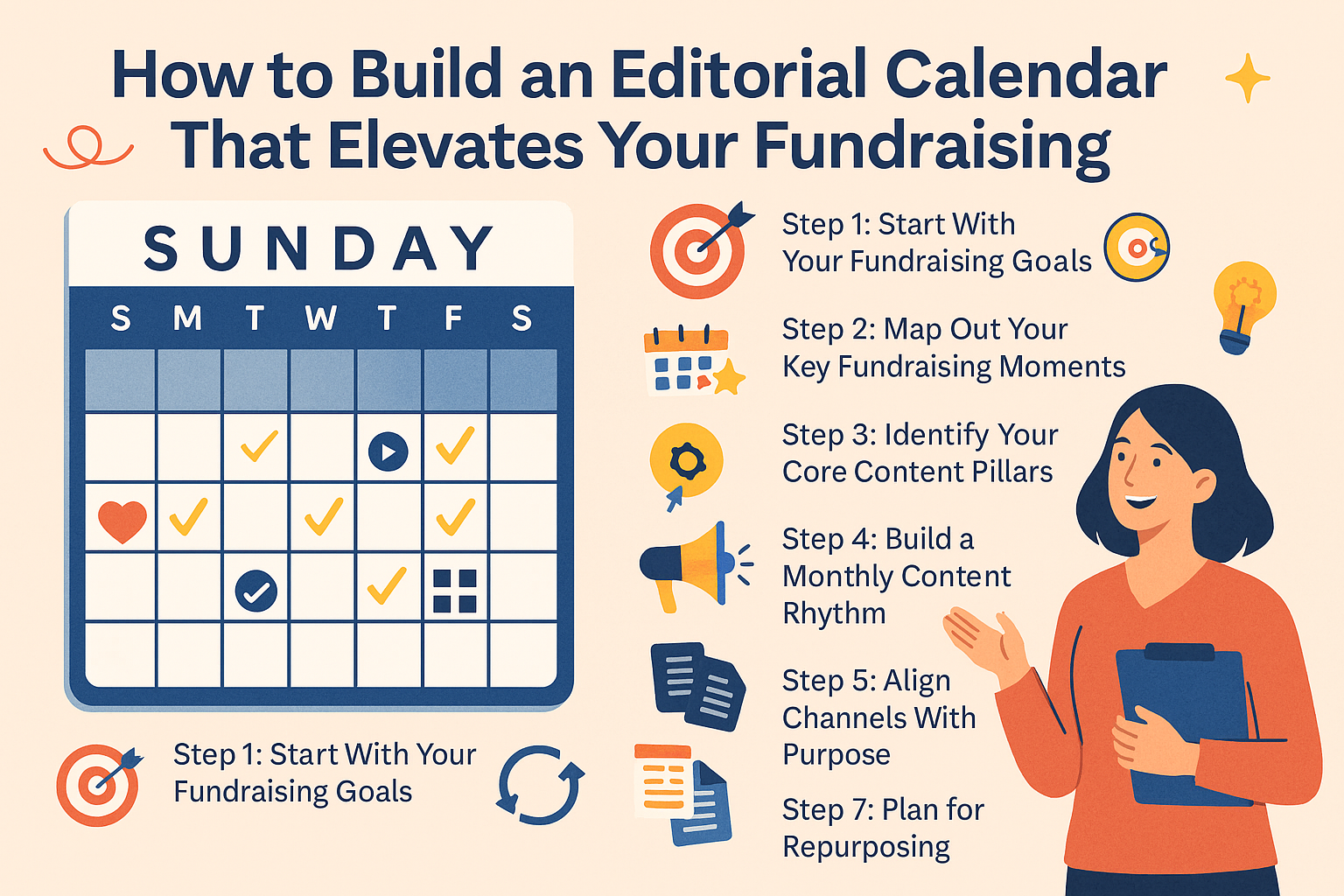
How to Build an Editorial Calendar That Elevates Your Fundraising
Refine Your Strategy. Elevate Your Impact.
If you’ve ever found yourself scrambling for content the night before a campaign launch or staring at a blank screen wondering what to post next, you’re not alone. Fundraising thrives on consistency, storytelling, and strategic timing. An editorial calendar is the tool that brings all three together.
A strong editorial calendar doesn’t just organize your content. It aligns your messaging with your fundraising goals, keeps your team focused, and ensures your donors hear the right story at the right time.
Let’s walk through how to build one that actually works.
Step 1: Start With Your Fundraising Goals
Before you plan a single post, email, or story, get clear on what you’re trying to achieve.
Ask yourself:
- What campaigns are coming up?
- What revenue goals do we need to hit?
- What donor segments are we prioritizing?
- What stories or programs need visibility?
Your editorial calendar should be a strategic engine, not a content dumping ground.
Step 2: Map Out Your Key Fundraising Moments
Think of your year in seasons, not just dates.
Examples:
- Quarterly campaigns
- Giving Tuesday
- Special events (fundraiser, gala, block party, school activations)
- Awareness months
- Program launches
- Impact report releases
Plot these anchor points first. They become the backbone of your calendar.
Step 3: Identify Your Core Content Pillars
Fundraising content works best when it’s predictable, purposeful, and varied. Choose 3–5 pillars that reflect your mission and donor motivations.
For example:
- Impact Stories — athlete features, student spotlights, family stories
- Behind the Scenes — staff insights, volunteer highlights, program prep
- Education & Advocacy — why your mission matters, data, trends
- Calls to Action — donate, volunteer, attend, share
- Gratitude — donor thank‑yous, milestone celebrations
These pillars keep your content balanced and mission‑aligned.
Step 4: Build a Monthly Content Rhythm
This is where your calendar becomes a system.
A simple monthly rhythm might look like:
- Week 1: Impact story
- Week 2: Behind‑the‑scenes post
- Week 3: Donor spotlight or gratitude
- Week 4: Call to action tied to your fundraising goal
Or, if you’re running a major campaign:
- Monday: Story
- Wednesday: Program highlight
- Friday: CTA (Call to Action)
- Weekend: Donor engagement or gratitude
Consistency builds trust and trust drives giving.
Step 5: Align Channels With Purpose
Not every message belongs everywhere.
Think strategically:
- Email: storytelling, appeals, updates
- Social media: quick hits, visuals, engagement
- Website/blog: long‑form content, SEO, evergreen stories (a piece of content that has timeless meaning. Ex: A program participant whose story reflects your mission)
- Print: donor packets, event materials, annual reports
Your editorial calendar should show what goes where and why.
Step 6: Plan for Repurposing
One story = multiple assets.
For example: A student success story can become:
- A blog post
- A social carousel (a multi-slide post on social media where you swipe through to see the slides. It’s like a mini-story)
- A donor email
- A short video
- A quote graphic
- A board update
Repurposing saves time and reinforces your message.
Step 7: Track What Matters
Your calendar isn’t just a plan; it’s a feedback loop.
Track:
- Engagement
- Click‑throughs
- Donations tied to content
- Email performance
- Social reach
- What stories donors respond to
This helps you refine your strategy month after month.
Final Thought
An editorial calendar isn’t about filling space; it’s about elevating your impact. When your content is intentional, consistent, and aligned with your fundraising goals, donors feel it. They see the mission more clearly. They understand the need more deeply. And they give more confidently.
A well‑built editorial calendar doesn’t just organize your year. It transforms your fundraising.